
Colegiado número 171: Alán Carrasco
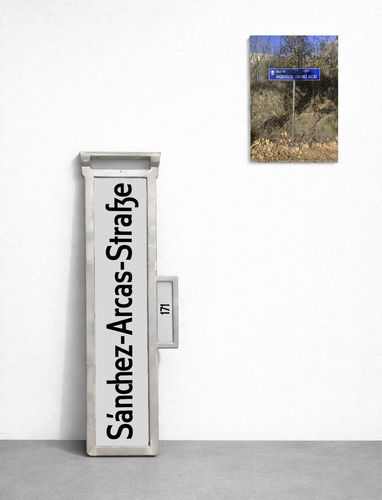
Street plate, 102 x 25 x 5 cm
Over the last two years, the project “Colegiado número 171” has followed the footsteps of Manuel Sánchez Arcas (Madrid, 1897 – East Berlin, 1970), one of the most important architects of Modernity in Spain who, nevertheless, remains practically unknown to the general public.
Trained in Madrid and London, and belonging to what is known as the Generation of ’25, Manuel Sánchez Arcas developed an institutional, technical, and political activity that placed him at the very center of the republican project, combining his role as a modern architect trained in the principles of constructive rationalization with a firm commitment to social transformation and public architecture. This ethical and political interest in architecture as a material response to devastation and as a tool for the future runs through the triptych Восстановление / Odbudowa / Wiederaufbau, which connects the early experience of the European ruins of the Great War with the central place that reconstruction would acquire decades later, during his exile.
In 1939, due to his positions within the republican administration and his role within the Central Committee of the PCE, he began a triple exile that, in his case, would be definitive. Thus, stripped of his professional registration and of the possibility of professional practice in perpetuity after the purges of architects carried out by the Francoist authorities, he would begin a vital, political, and professional journey on the other side of the Iron Curtain, moving through Moscow (1939–1947), Warsaw (1947–1958), and finally East Berlin (1958–1970). Carrasco also addresses the closed-off bifurcations of this biography, as in Einbahnstraße. Embajada mexicana, where a visa granted by the government of Lázaro Cárdenas opens the possibility of an alternative exile that never came to materialize, underscoring the irreversibility of political decisions that fix a destiny in one direction and not in another.
The three countries of his exile constituted a political landscape that, despite their affinity, were not especially favorable to his talent, relegating him on many occasions to technical work without recognition of his authorship. This condition of professional survival, marked by a constant balance between fragility and resistance, appears in Un riesgo calculado, where the reinforced concrete shell structures studied by Sánchez Arcas become metaphors for a life subjected to extreme tensions. It becomes necessary to adapt without breaking, to sustain oneself within a minimal architecture, to
assume each gesture as a carefully measured risk.
Nevertheless, he once again found himself surrounded by major events that shaped much of the twentieth century and of our present. In this context, architecture is also revealed as a material archive of geopolitical conflict. The work Хронотоп [Cronotopo] reproduces secret U.S. reports on the production of civil construction materials in the Soviet Union, so that the support does not illustrate the content, but rather embodies it. In these materials, the historical time of the Cold War and the slow temporality of constructive matter overlap, condensing the political dimension of socialist (re)construction.
In this sense, Carrasco’s project revolves, fundamentally, around two tropes. The first is connected to the idea of “reconstruction” as a foundational myth of the three countries of Sánchez Arcas’s exile, paradoxically three states that no longer exist today. The second, and in parallel to the former, focuses on the contradictory “construction of peace” or “Soviet Pax,” as part of the agenda of the USSR and its allies in the complex division of a bipolar world during the Cold War. Both axes unfold clearly in Po wszystkim [Después de todo], which takes Polish a poster of the reconstruction of Warsaw as its starting point and transforms it into an immersive visual landscape, where the promise of peace coexists with the persistence of latent conflict.
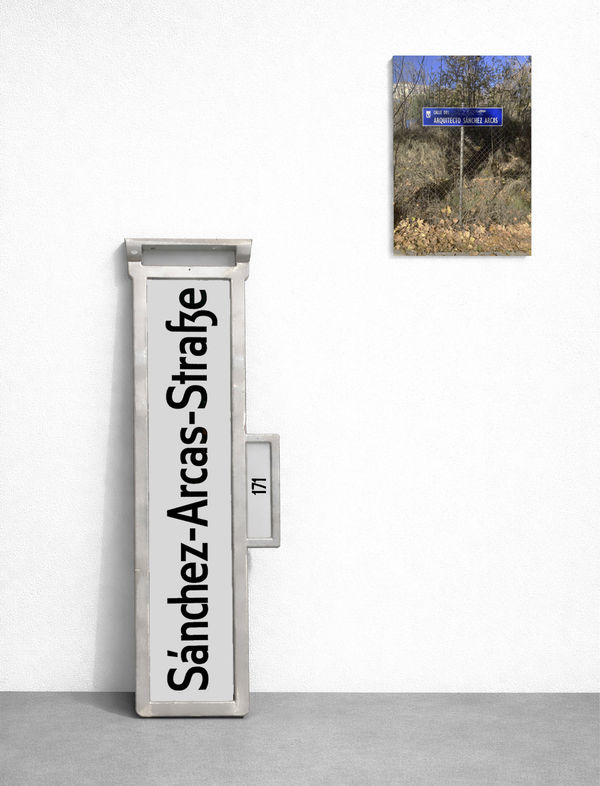
Aus dem Osten kommt das Licht scrutinizes the conditions under which the memorial policies of cities operate, from the minimal street dedicated to Sánchez Arcas in Madrid in 2017 to the latent, and perhaps impossible, possibility of an inscription in Berlin. The piece thus underscores the difficult balance by which decisions are fixed regarding what or whom it is legitimate to remember in public space, especially when testimonies from another era are displaced or erased.
Ultimately, the project “Colegiado número 171” delves into issues previously present in Carrasco’s work, such as the history of republican exile (also of that more uncomfortable kind, such as that which took place in Eastern countries); the possibilities of History, in this case proposing uchronian alternatives to the biography of Sánchez Arcas himself; or what and whom can be remembered from Western historiography when a process such as the concatenated collapse of the Eastern bloc takes place and the destruction of testimonies from another era (now negatively connoted) becomes especially common.
Alán Carrasco carried out this study during a residency for artistic research projects linked to the activity of the Museo Nacional Centro de Arte Reina Sofía, within the framework of the Recovery, Transformation and Resilience Plan.

-
 Alán Carrasco, Aus dem Osten kommt das Licht, 2026
 -
Alán Carrasco, Хронотоп [Cronotopo], 2026
-
Alán Carrasco, Einbahnstraße. Embajada mexicana, 2026
-
Alán Carrasco, Po wszystkim [Después de todo], 2026
-
Alán Carrasco, Un riesgo calculado, 2026
-
Alán Carrasco, Восстановление / Odbudowa / Wiederaufbau, 2026
![Alán Carrasco, Хронотоп [Cronotopo], 2026](https://static-assets.artlogic.net/w_600,c_limit,f_auto,fl_lossy,q_auto/artlogicstorage/adngaleria/images/view/6978f941f0628fb04f13b3bd7170cea7j/adngaleria-al-n-carrasco-cronotopo-2026.jpg)

![Alán Carrasco, Po wszystkim [Después de todo], 2026](https://static-assets.artlogic.net/w_600,c_limit,f_auto,fl_lossy,q_auto/artlogicstorage/adngaleria/images/view/2127406553be165778d93f180a11b45fj/adngaleria-al-n-carrasco-po-wszystkim-despu-s-de-todo-2026.jpg)


