
How to write from trauma? My body harbours inherited traumas, I am a fervent believer in this idea; I can say so from situated knowledge because my grandparents, my father, my uncles and aunts who were repressed and subjected to violence during a war and the years that followed transmitted them to me (those who speak of forgetting do so because they lack a memory with wounds). I also shelter traumas lived in my own flesh, which have passed through my body and transformed it, which dwell in the scars I slowly trace with my finger as a somewhat naïve way of healing a little more each day; because healing from trauma is not forgetting, but remembering and turning pain into something else.
My colleague Marina Vargas, who transforms trauma into a creative act, asked me to write about her latest exhibition, a work pervaded by pain, by fear, but also by courage; pieces that speak of the body, of the canon, and of beauty, but of an “other” beauty alien to Apollonian bodies, a beauty found in the folds of flesh, in accumulated fat, in sweat, in the rediscovery of pleasure and of joy, which, why not, blossom from the bulging scar of non-normative bodies. I accepted without hesitation because we have both travelled through the same illness, because I too have had a mastectomy.
It has cost me to write about trauma, about cancer, among other things because, although I had talked about it a great deal I had not done the exercise of vomiting it into a text; perhaps I lacked the courage to face what was happening to me from within the realm of creation, perhaps I fled towards subjects that unsettled me less. But, when I came across Marina Vargas’s work in exhibitions and we still knew each other only superficially (That Noli me tangere. The incredulity!), I envied that woman who had decided to heal her traumas through production, as a way of making. Those who have not lived it will perhaps find it strange that Marina and I speak of cancer as something naturalised, and that, at times, without verbalising it we know, and we laugh at past episodes: because, although experiences are always different in each body, there is a part that is common. Working on trauma is a delicate act, but at the same time ferocious, one of bravery.
Marina Vargas has drawn on the vast options offered by contemporary visual language and its disciplines to recount in a sharp, radical, incisive and profound manner what words sometimes fail to tell. Trauma resides in the body because it came from the body, and there were silences, but also screams. In her work one hears a poetic body, but equally a political one, in images that are truth, sincerity, in a tempered and paradoxically abyssal manner that I have rarely encountered. She draws on references to art history, fundamentally the representations of canonical bodies inherited from classical Antiquity (seven heads, seven and a half, eight, eight and a half, nine… great dilemma), but also on analogies and resources that come in many cases from the unconscious and from letting the mind fly without limits, from chance… or from moving through life without pretence, sometimes abruptly, at other times in gushes. In these pieces dwell affections, tactility, fragmented memories…, and she permits herself to speak in leaps; linearity is superfluous because the artist accepts confusion and error as a mode of knowledge, as an almost magnetic formula of creation that infuses guidelines and energy to continue meandering around what happened and what that left us: fear, fragility, strength… the friends who accompanied us in moments of panic.[1] Addressing trauma does not seek to close it, but the simple act of generating an image about what was lived is a form of reparation and also of resistance that makes evident to what degree illness and the formulae through which it is protocolised also have a gender.
The first works by Marina Vargas that this exhibition at the ADN gallery recovers receive us from behind, reflected in a large mirror. They are the sculptures that composed the corpus of the project Ni animal ni tampoco ángel and which evidenced the construction of gender, demanding both a symbolic and political reading of women’s bodies.[2] By appropriating and manipulating statues from European classical Antiquity that have served for centuries to set the canon, the stereotypes of beauty, and that represented certain archetypes whose origins sink into very remote times, she demonstrated how women (and in this the nineteenth century was especially cruel) were tied to scarce symbolic options: they could be objects of desire, sacrificed angels of the home, and, as in Puccini’s operas, symbols of the redemption of sin that, for females, was the hypostasis of lust and “uncontrolled” love).
In these works, which ooze a pink material somewhere between magma and candy floss,[3] the artist situates herself in a new place that questions the Manichean readings of the two spheres: she demonstrates that the construct “gender” is pure violence, relationships designed for power or submission, an inherited framework that serves no purpose. Marina Vargas rejects these categories and proposes another space; in reality, a limbo in which there is no possibility of conciliation, a realm in which the reading of the image cannot be anything other than political and is so, moreover, because it resists classification.
Vargas appropriates monuments precisely because they are born with a vocation of permanence and representation. And therefore she generates new ones showing what is hidden, rendered invisible: a “incomplete” female body does not exist for the canon (let us recall on the Fourth PlinthofTrafalgar Square the Alison Lapper Pregnant (2005), by Marc Quinn, a white marble sculpture that referred to Graeco-Roman statuary portraying pregnant and nude this British artist born without arms and with short legs). Monuments construct a symbolic hierarchy in which men tend to have names and are examples of behaviour or heroes, while female bodies are always allegorical (let us recall in Spain Influencia cultural, y nada más que cultural, de la mujer en las artes arquitectónicas, visuales y otras by Paz Muro: in collaboration with Pablo Pérez-Mínguez she photographed female statues in Madrid in 1975, underlining that they are never real historical subjects). And the fact is that women could only be read, I insist, as the pure instinctive and exultant nature of surrealism, the “sweet” submission that generated the construct of “angel of the home” or the unattainable spiritual ideal of the weightless and ethereal woman in the nineteenth century. And Vargas is categorical: women are not a construct, but different subjects, citizens who are each born in a specific context, embodied subjects.
There is something visionary in these pieces predating the illness: what is that magmatic and ambiguous material that emerges from the sculptures or invades them, that grows in the face of the impossible resistance of marble made symbol, yet inanimate? We have a long tradition of visionaries in the history of culture: from the Sibyls who grazed the future with a riddle without managing to recount or enter into detail, to Hildegard von Bingen with her prophetic contemplations sheltered within the realm of mysticism. Women, in general, as illustrated by the myth of Cassandra, were discredited, silenced, and when not, pointed out as witches to be watched burning tied to a wooden stake. More recent examples take me to the chewing gums Hannah Wilke stuck to her body as decorations, but also as stigmas in S.O.S.– Starification Object Series (1974–82) only to be diagnosed shortly afterwards with a lymphomaand leukaemia; between 1989 and 1993, Wilke documented her illness in the series Intra-Venus. Moving away from the illness of the body to enter that of souls, the novel The Handmaid’s Tale by Margaret Atwood is a dystopia, a warning, that seems closer than we ever imagined.
At the Robayera gallery, a space programmed at the time by Marta Mantecón, Marina Vargas brought together some of the pieces from the previous series and added others under the title Intra-Venus, borrowed from Hannah Wilke. The title refers in the first instance to the goddess Venus, a stereotype of idealised beauty made to be contemplated, for scopic pleasure; but we are more interested in the “intra” that co-substantiates the goddess of love: the “intra” connects the skin to the interior and ventures into the internal, the viscera, the entrails, mucosities, fluids and organs that sustain life and which remain hidden beneath the skin: «Ce qu’il y a de plus profond chez l’homme, c’est la peau» said Paul Valéry; she is skin of polished white marble without wrinkles to age her, but she is also wounds, scars, tumours and humours, elements apparently in conflict but which coexist, need one another from the origins of life.
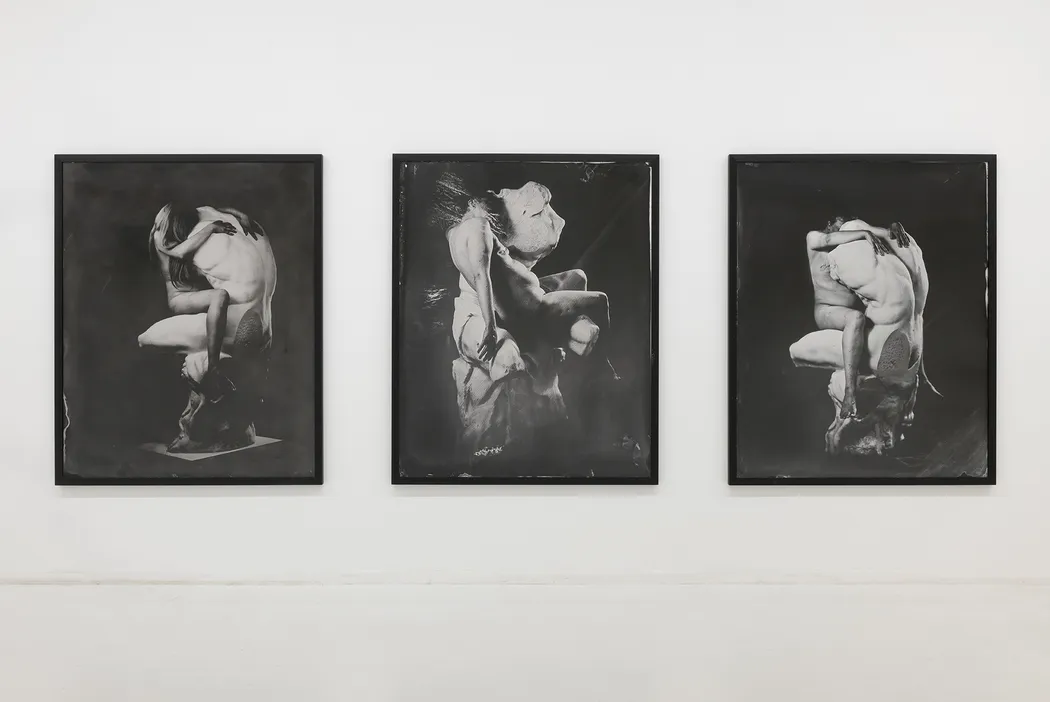
In the metal and black wet collodion glass photographs, the female body, that of the artist herself after surgery, the chemotherapy, radiotherapy and hormonal treatments with Tamoxifen, is presented as a symbolic battlefield.[4] It is a body that, at times emulating the eroticised position of a venus, joins reclining the erect Victory of Samothrace, one of whose wings emerges from Vargas’s back (Has she fallen like Icarus? Has she kept the wing as a symbol of her victory over pain and the context of illness?). It is a nude body that disturbs, that cannot be objectified: it is not smooth, it is not cold, it has pubic hair and scars, the head has lost the long and silky hair of a “nymph”, of an ethereal being. It is a body that weighs and that does not offer itself to the gaze, but rather expels it, disturbs it. It is a rebellious, resistant, real, carnal, visceral, bruised body, a body that rises up and raising its fist signals its strength as a form of resistance. A situated body, individualised in pain and lack, pregnant with memory and time, that climbs atop the sculpture of the most beautiful torso ever sculpted, that of the Belvedere in the Vatican collections: this at times embraces her as in a Pietà (the body of the artist incarnated in the image of Christ), at others it seems to couple in a copulation.
There is nothing more thunderous than the silence of these photographs.
Isabel Tejeda
Professor of Fine Arts at the University of Murcia, curator and art critic.
Her research focuses on exhibition design and narratives of contemporary art, the history of exhibitions and museums; the history of women, feminisms, and contemporary art.
She obtained a degree in Geography and History, specializing in Art History, in 1990. She holds a PhD in Fine Arts from the Polytechnic University of Valencia (2009), where she received the Extraordinary Doctorate Award for her thesis “From Exhibition to Re-exhibition: Semantic Shifts of the Artwork of the Historical Avant-Gardes in Its Process of Museification. From Insurrection to the Return to Order.”
Between 1991 and 1995, she was director of the Eusebio Sempere Center (Alicante), located in the Gravina Palace, where she transformed its galleries into a benchmark for contemporary art in the city. From the end of that decade until 2010, she was in charge of Espacio AV and Sala Verónicas (Murcia). She also worked as head of exhibitions and professor at the Istituto Europeo di Design in 2006–2007.
Since 2004, she has been a professor at the Faculty of Fine Arts at the University of Murcia. She was also co-director of the Master’s Degree in Cultural and Historical Heritage Management at the Complutense University of Madrid from 2009 to 2012.
She has delivered numerous courses and lectures at various Spanish and international universities; she was director of the International Landscape Workshop in Blanca (Murcia) from 1998 to 2010, aimed at contemporary artists.
She has curated nearly one hundred exhibitions in Spain, France, Italy, the United Kingdom, the Czech Republic, Morocco, Puerto Rico, and Argentina.
She was a member of the international jury of the Cairo Biennial (Egypt) in 2006; a member of the jury for the Spanish National Prize for Visual Arts in 2009 and 2022; and a member of the Velázquez Prize jury.
Espais Prize, 1996; finalist for the Arte y Derecho Foundation Essay Prize, 2005; Precrea Juana Francés Prize of the Valencian Universities, 2020; Anetta Nicoli Chair Prize, UMH, 2021; Award for the dissemination of research led by women, University of Murcia, 2021.
As a feminist, she has been part of the founding board of the association Mujeres en las Artes Visuales.
[1] Thank you, thank you, Yen and Marina.
[2] The artist appropriated a poem by Sylvia Plath for the title of this 2015 exhibition at the CAC in Malaga. A title she returns with struck through in this show.
[3] They are made of expanded polyurethane, so the final form of the work is generated slowly, while the artist sleeps.
[4] Vargas makes use of this technique because it was used by medical photography in the nineteenth century, a period in which, for medicine, women were eternal invalids by virtue of being born with a uterus. Faced with the impossibility of diagnosis, they were immediately medicalised and in many cases committed to institutions.
